Who Decides What Gets Our Attention?
CFY Introduces 25 Exercises to Rethink How We Focus, Organize, and Respond
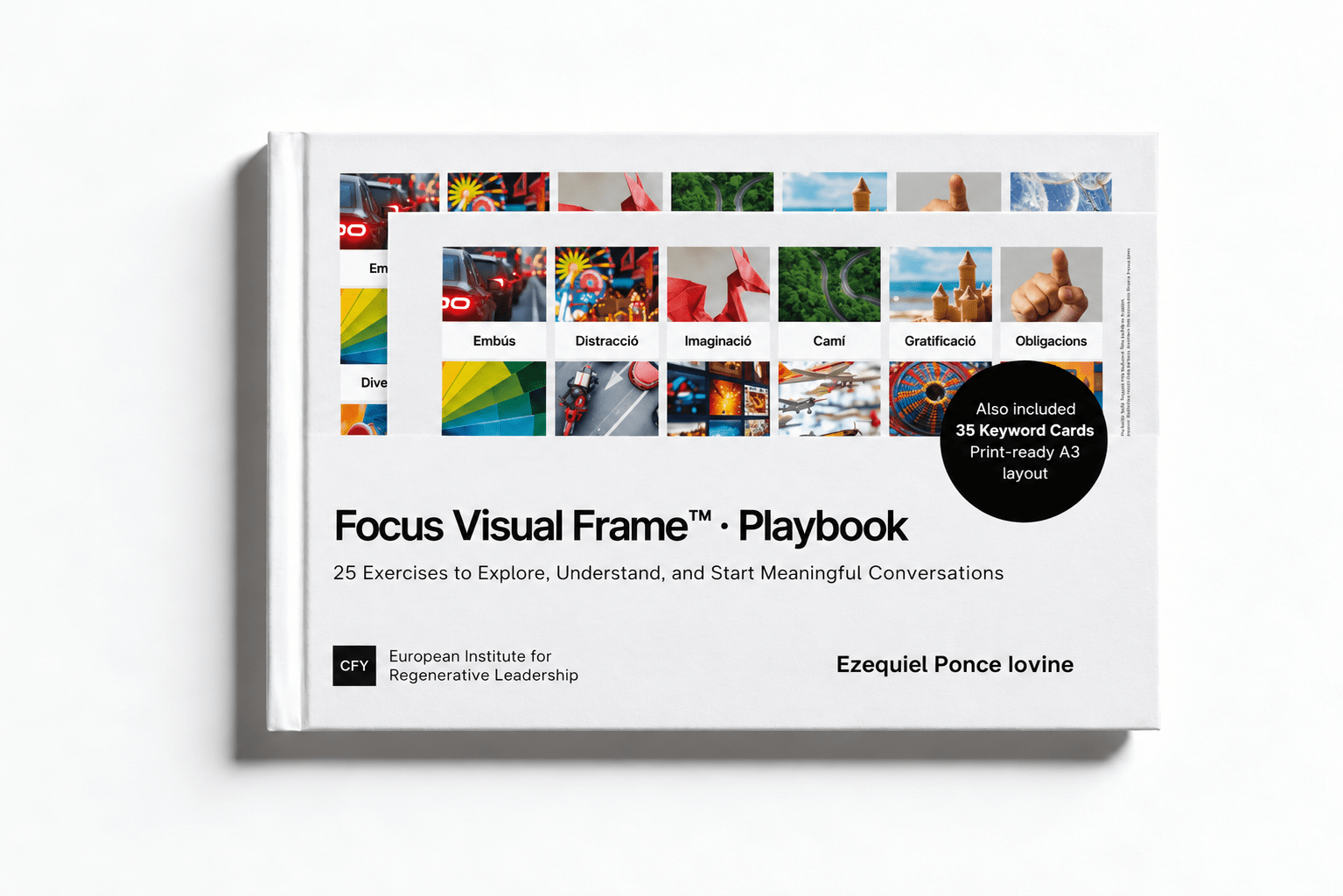
Focus Visual Frame™ and its new Playbook offer a practical, visual approach to exploring how we direct our attention, navigating everyday demands, and discovering new ways to respond—both individually and in teams.
Madrid, November 6, 2026. Nearly half of employees (48%) and more than half of business leaders (52%) surveyed by Microsoft describe their work as chaotic and fragmented. According to Microsoft’s 2025 Work Trend Index, among Microsoft 365 users receiving the highest volume of notifications, emails, messages, and meeting invitations arrive, on average, every two minutes during core working hours (Microsoft, 2025).
These findings reflect an increasingly familiar reality: countless activities compete for our attention simultaneously. Meetings, messages, responsibilities, commitments, and unexpected demands shape workdays in which distinguishing what is urgent from what truly matters, understanding how we allocate our efforts, or finding alternatives to our habitual responses is not always easy.
Research also suggests that the consequences extend beyond concentration. A 2025 study involving 91 employees found that personal smartphone interruptions could indirectly increase frustration by interfering with task completion, with potential implications for psychological detachment from work after working hours (Derks et al., 2025).
Against this backdrop, CFY introduces Focus Visual Frame™ and its 25-Exercise Playbook, a practical approach designed to make attention something we can observe, explore, and discuss—rather than treating it solely as an individual ability we must constantly strive to improve.
25 Exercises to Turn Reflection into Practice
The new offering combines Focus Visual Frame™, a visual exploration tool, with a Playbook featuring 25 practical exercises organized into five complementary areas of exploration.
Focus Visual Frame™ provides a visual framework built around 35 keywords, also available as cards, that help people recognize different aspects of their attention, experiences, daily activities, and habitual ways of responding.
The Playbook transforms these resources into guided experiences that encourage people to pause, examine specific situations, express what they are experiencing, and consider different perspectives.
One of its defining strengths is its accessibility: no prior knowledge is required, the exercises can be completed individually or with others, and there is no need to follow a fixed sequence.
Each activity includes a clear purpose, an introduction, step-by-step instructions, and a closing reflection, making it easy to integrate into a wide range of personal and professional settings.
Five Ways to Explore Our Relationship with Attention
The 25 exercises are organized into five complementary areas:
- Observing our experiences. Recognizing what captures our attention, how we experience different situations, and which aspects of our everyday lives often go unnoticed.
- Recognizing demands on our attention. Exploring the pressures, interruptions, responsibilities, and expectations competing for our attention in personal and professional life.
- Understanding how we organize ourselves. Examining how we structure activities, manage priorities, and respond to different commitments.
- Exploring our responses. Identifying habitual ways of acting and considering alternatives when situations require attention, organization, or decision-making.
- Opening up conversations. Sharing perspectives, recognizing differences, and exploring together how we experience and respond to the demands of our surroundings.
This flexible structure allows individuals, professionals, and facilitators to select exercises according to the needs of each person, session, or group—without turning the experience into a rigid program.
One Tool, Multiple Applications Across Personal and Professional Life
The flexibility of the format opens up a wide range of practical applications.
- For personal development, the exercises can help people recognize how they distribute their attention across responsibilities, activities, relationships, and everyday needs. They also provide opportunities to explore situations involving overload, distraction, or uncertainty about where to begin.
- For coaching and professional support, they offer structured resources to facilitate reflection, formulate meaningful questions, and explore specific situations without relying entirely on spontaneous conversation.
- For learning and facilitation, the exercises can be incorporated into workshops, learning experiences, and participatory activities that combine visual exploration, reflective writing, and conversation.
- For teams and organizations, they provide a starting point for conversations about priorities, interruptions, coordination, availability, and different ways of organizing work. Their value lies not only in exploring individual habits but also in making visible the shared conditions that influence how people work and collaborate.
A Practical Approach That Goes Beyond Productivity Advice
Unlike resources focused exclusively on techniques for improving concentration or completing more tasks, Focus Visual Frame™ begins with a more fundamental question: What is really happening with our attention?
From this perspective, understanding how we pay attention involves examining not only our individual choices and responses but also the demands, relationships, and environmental conditions that shape them.
The aim is not to prescribe a single way of organizing our lives or working more efficiently. Instead, it is to provide practical resources for observing experiences, recognizing patterns, exploring alternatives, and creating space for conversations that often get overlooked in everyday routines.
Focus Visual Frame™ and its Playbook are part of the CANVAS FOR YOU® Focus™ ecosystem, developed around an approach that brings together learning, reflection, and the exploration of new possibilities for responding to everyday challenges.
Accessible, Flexible, and Ready-to-Use Tools
The Playbook and its visual resources are designed as downloadable, printable digital materials that can be easily integrated into individual sessions, meetings, workshops, and professional development activities.
With 25 exercises and 35 keywords serving as starting points for exploration, the initiative aims to make new ways of understanding and discussing attention more accessible through simple, concrete, and adaptable experiences.
Because before deciding how to make better use of our attention, we need to understand what occupies it, what shapes it, and what possibilities we have to direct it.
About CFY · European Institute for Regenerative Leadership
CFY develops visual tools and learning methodologies designed to facilitate reflection, expression, meaningful conversations, and the exploration of new possibilities for action. Its ecosystem brings together practical resources for personal and professional development, individual and team support, facilitation, and learning and transformation processes.
For more information: www.canvas-for-you.com
Research References
Microsoft. (2025, June 18). Breaking down the infinite workday [Spanish-language edition]. Microsoft Source EMEA. https://news.microsoft.com/source/emea/features/98377/?lang=es
Derks, D., van Mierlo, H., & Kühner, C. (2025). Unfinished tasks and unsettled minds: A diary study on personal smartphone interruptions, frustration, and rumination. Behavioral Sciences, 15(7), 871. https://doi.org/10.3390/bs15070871