
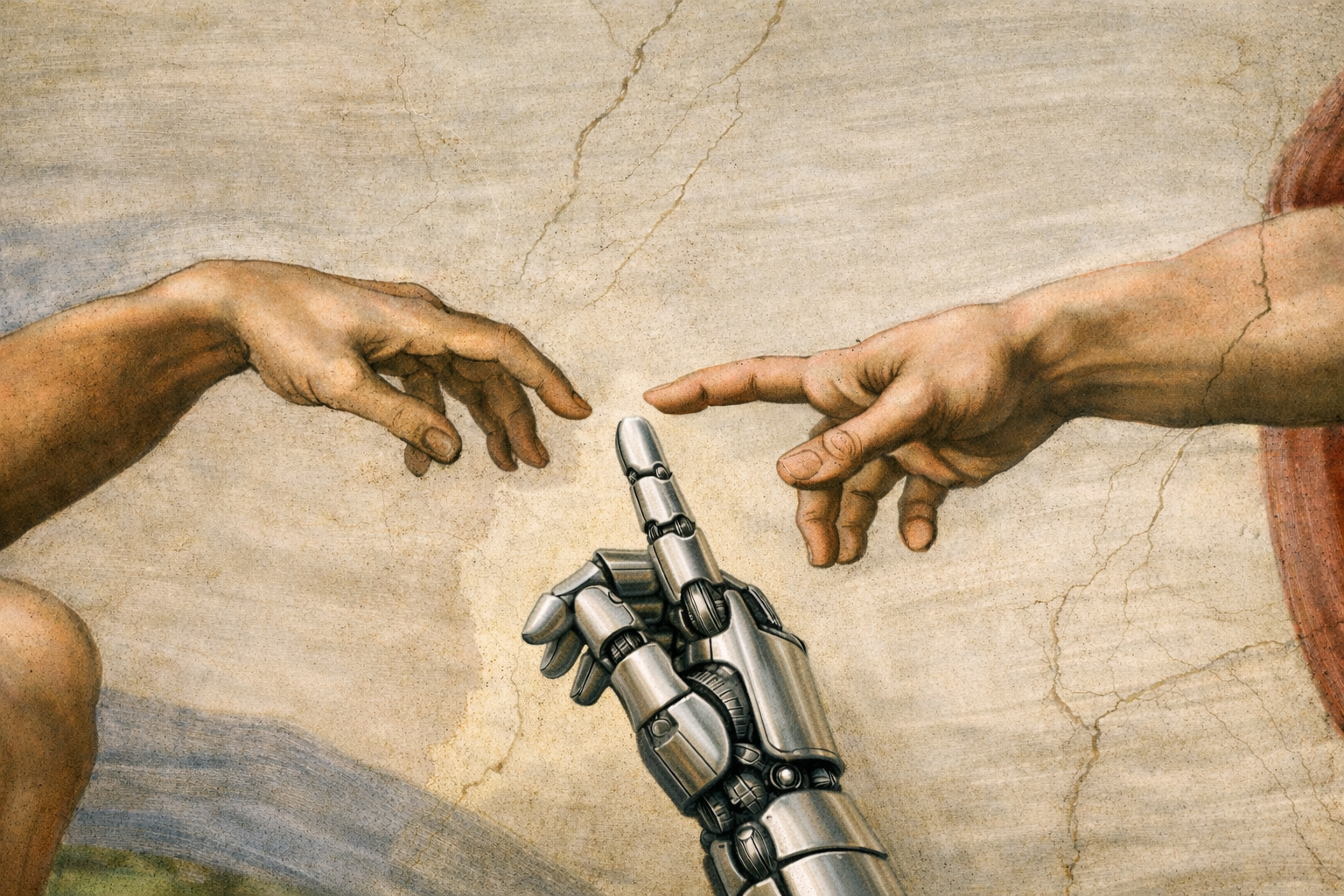
Humans, Robots & Culture
On February 24, 2026, OpenAI appointed Arvind KC as Chief People Officer. The company described the decision by saying KC brings a “rare combination of deep engineering expertise and people leadership.”
Before joining OpenAI, he had already held an explicitly hybrid role at Roblox: Chief People & Systems Officer, described by the company as operating “at the intersection of technology and people leadership.” Unsurprisingly, many People & Culture leaders began asking what signal their field should take from that move.
Personally, I do not think the signal is that People matters less. I think the signal is that People, understood only through the traditional HR lens, is no longer enough.
From People Experience to the Full System
The design challenge is no longer limited to the experience of people inside the organization. It now extends to the full work system: who does what, what a person decides, what a system executes, how work is supervised, how learning happens, and how all of it is coordinated without weakening culture, accountability, or performance.
This fits a broader pattern. The World Economic Forum identifies technological change as one of the major forces reshaping labor markets through 2030, while Microsoft is already describing the rise of “hybrid teams” made up of humans and agents inside organizations. More precisely, this paradigm shift is not about moving from people management to technical management. It is about moving from a People function centered on the workforce to one capable of designing sociotechnical systems.
That is why leaders with a real understanding of engineering, scalability, systems architecture, and high-performing technical teams are becoming especially valuable in this role. In fact, OpenAI frames the position in exactly those terms: how jobs are changing, what new capabilities are needed, and how to support the transition toward work increasingly enabled by AI.
The OECD is already formalizing the language around agentic AI and AI agents, and Microsoft is openly discussing organizations structured around humans and agents. Humanoids and physical robotics are also advancing, but for now their deployment remains more closely tied to industrial and service operations. Even sector institutions distinguish between long-term vision and present reality, pointing to safety, cost, and integration barriers before large-scale adoption becomes viable.
Toward a Mixed Ecology of Contribution
Perhaps the future of the function is no longer only about People & Culture. Perhaps it is about Humans, Agents & Culture. And, in certain sectors, later on, also about Humans, Robots & Culture. The key shift is that the organization is no longer composed only of people. It is beginning to operate as an ecology of mixed contribution.
At the same time, I do not believe this diminishes the value of psychology, sociology, anthropology, or organizational development. If anything, it raises the bar for the function. The more technological the architecture of work becomes, the more essential specifically human capabilities become in sustaining judgment, meaning, learning, ethical discernment, connection, and cultural interpretation.
The broader conversation around skills is moving in that same direction: as AI expands, demand for human capabilities rises as well. But these are not human capabilities in the way L&D has typically framed them until now. Complexity does not live only out there. It runs through everything. If this is a conversation your organization is beginning to face, I would be glad to explore it with you.
Expanding the Frame. Designing a New Profile
We are entering a phase in which the People function needs to expand its frame radically. It is no longer only about attracting, developing, and supporting talent. The future of People lies in designing coordination, collaboration, and coexistence among people, artificial intelligence, and, eventually, robots or humanoids.
That requires a profound shift: from people management toward work architecture, capability governance, and the cultural stewardship of hybrid environments.
In that context, organizations will need a new generation of People leaders. Leaders able to read the human dimension, understand the technical one, and translate both into structures that are viable, ethical, and strategically sound. The function is moving beyond people management alone and becoming, progressively, a discipline of work design, capability governance, and cultural stewardship for hybrid systems.
Strategic Direction and Leadership Conversations
Is your organization asking the right questions? Is there enough openness emerging to address these conversations with agility, clarity, and rigor?
We are talking about the future, yes, but not a distant one. These issues are already showing up across leadership agendas. And the right mindset, the right frame, and the right questions are what make the right decisions possible. This is not about chasing trends. It is about designing an architecture of your own to operate in this new reality.
Would a few strategic conversations help your organization gain perspective? Let’s talk.
Ezequiel Ponce Iovine
Founder CANVAS FOR YOU®
Tag:AI, AI Agents, Change, Leadership, People & Culture
